In the field of construction, the selection of scaffolding support systems is directly related to construction safety and project efficiency. Recently, a case of foundation pit deformation caused by the illegal use of light steel supports instead of heavy-duty ones in a deep foundation pit project has once again aroused industry attention to the issue of steel support selection. This article will systematically analyze the core differences between heavy-duty and light-duty steel supports, providing a scientific basis for construction parties to select appropriate supports.
Technical Parameters: Fundamental Differences from Material to Performance
Technical Parameters: Fundamental Differences from Material to Performance
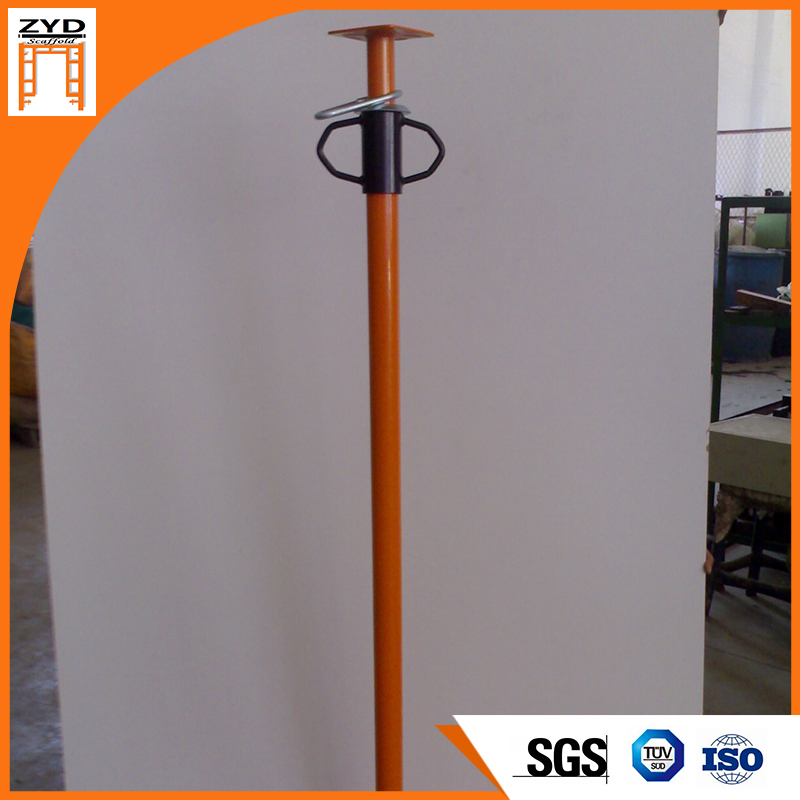
The performance differences of steel supports are first reflected in technical parameters. According to industry data, light steel supports typically have an inner tube diameter of 40-48mm, wall thickness of 2.0mm, outer tube diameter of 56mm, adjustable height range of 1.6-3.5m, and allowable load of 11.89-33.32kN (approximately 1.2-3.4 tons). Each light support is relatively lightweight; for example, the Zc-3 model has a total weight of only 15.5kg, facilitating manual handling and installation.
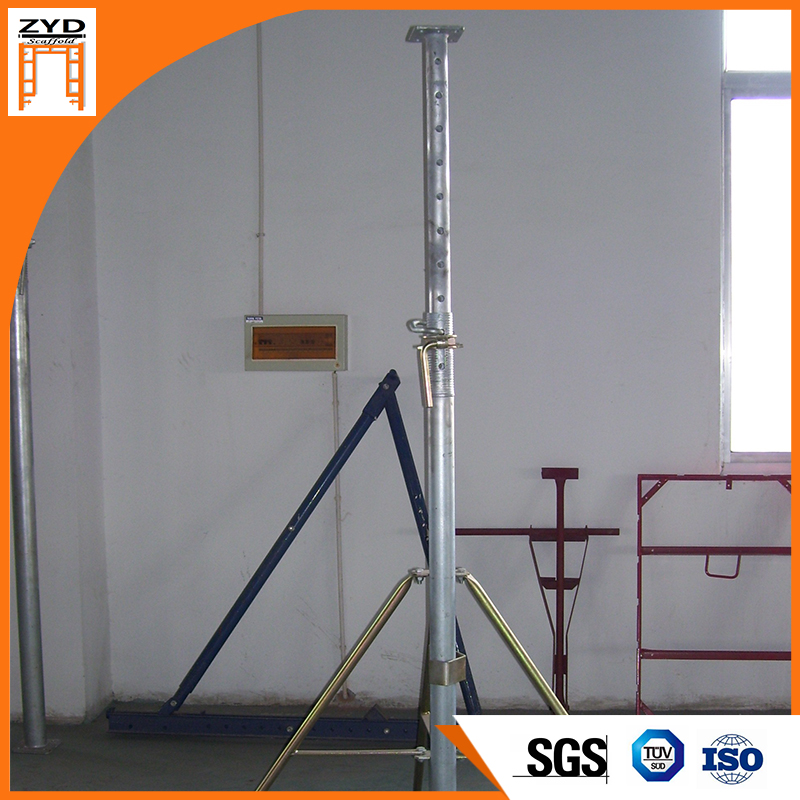
Heavy-duty steel supports exhibit stronger structural strength, with an outer tube diameter of up to 60mm, and some models have a wall thickness increased to 3.5mm. Their maximum adjustable height can reach 5.0m, and the maximum allowable load is 44.1kN (approximately 4.5 tons). Taking the Type III heavy-duty support as an example, its upper tube diameter is 60mm, lower tube diameter is 75mm, and both have a wall thickness of 3.2mm, significantly improving buckling resistance. This difference stems from material mechanical design: heavy-duty supports adopt higher-strength Q345B steel with a tensile strength ≥345MPa, ensuring structural stability under heavy loads.
Scenario Adaptation: Project Requirements Determine Support Type
Different project characteristics impose differentiated requirements on steel supports. Light steel supports, leveraging their flexibility advantages, are widely used in low-rise building construction, interior decoration projects, and formwork support systems with small loads. A 3-story office building renovation project adopted light adjustable supports, utilizing an adjustable height range of 1.8-3.5m and arranging vertical poles at 1.5m intervals, which not only met construction needs but also reduced material costs.
Heavy-duty steel supports are the first choice for heavy-load projects. In deep foundation pit projects such as subway stations and interval tunnels, heavy-duty supports balance earth pressure on both sides of the foundation pit through a pre-stressed axial force monitoring system, preventing deformation and collapse of retaining structures. An 80-meter-high commercial complex project adopted cantilever scaffolding paired with heavy-duty steel supports. The vertical pole spacing was reduced to 1.2m×1.2m, and a double horizontal bar and dense diagonal bracing design were implemented. Third-party testing showed a maximum deformation of only 2.8mm, far below the specification limit.
More precise selection is required for special environments. Industrial plants need to resist lateral braking forces of cranes, and large-span stadiums must cope with strong wind loads—these scenarios all require heavy-duty supports to build stable lateral force resistance systems. In construction on slopes or soft soil foundations with complex geological conditions, a combined scheme of light steel supports and pile foundation reinforcement can ensure stability while avoiding material waste.
Scientific Selection: Establishing a Five-Dimensional Evaluation System
Construction parties should comprehensively evaluate selection decisions from multiple dimensions:
Load calculation is the primary basis. According to the Code for Loads on Building Structures, dead loads (scaffolding self-weight of approximately 3.84kg/m), live loads (2-3kN/m² for construction personnel and materials), and wind loads (0.3-0.5kN/m²) must be considered simultaneously. When the calculated total load exceeds 33kN, heavy-duty supports should be directly selected.
Construction period and efficiency affect cost control. Light supports are installed 30% faster than heavy-duty ones, making them suitable for low-rise projects with tight schedules; although heavy-duty supports take longer to install, they reduce the frequency of later maintenance and adjustments, making them more economical throughout the full cycle of large-scale projects.
Environmental adaptability cannot be ignored. For construction in coastal areas, corrosion factors should be considered, and galvanized heavy-duty supports can be selected; in earthquake-prone areas, priority should be given to buckling-restrained braces (BRB) with energy-dissipating properties.
Safety redundancy needs to be reserved. High formwork areas require vertical pole step spacing ≤1.8m and diagonal bracing set at 45°-60° angles. Heavy-duty supports have more sufficient safety reserves under such strict requirements. A project verified the reliability of heavy-duty supports under extreme working conditions through a static load test at 1.2 times the design load.
Cost structure should be fully accounted for. Light supports have a lower unit price, but their dense arrangement in heavy-load scenarios leads to increased total costs; heavy-duty supports require higher initial investment but can be reused 5-8 times, offering long-term advantages.
Safety Specifications: Dynamic Management Ensures Construction Safety
Regardless of the support type selected, safety standards must be strictly implemented. Before material delivery, inspections should confirm that steel tube wall thickness ≥3.6mm, corrosion depth ≤0.5mm, and fastener anti-slip coefficient ≥0.85. During installation, flange connections of heavy-duty supports require symmetrically tightened bolts, while light supports must ensure reliable locking of adjustable points.
A dynamic monitoring mechanism should be established during construction: daily inspections of fastener tightness and vertical pole perpendicularity; comprehensive inspections after winds of level 6 or above or heavy rain. A subway project successfully avoided foundation pit deformation risks by real-time monitoring changes in steel support axial force, promptly detecting abnormalities, and adjusting pre-stress. Demolition operations must follow the "top-down, first-built-first-dismantled" principle, and material throwing is prohibited.
Industry experts emphasize that steel support selection is not a simple technical issue but a strategic decision concerning the entire project. With the development of new material technologies, a new generation of support systems combining light-duty characteristics and heavy-load capacity may emerge in the future. However, in current engineering practice, strictly adhering to specifications and standards and scientifically selecting supports based on actual project needs remain key to ensuring construction safety and efficiency.